Beyond Time Estimation: Replacing Internal Clocks with External Anchors and Buffer Math
Published on August 07, 2026
Minimum Viable Action (MVA)
Outsource time tracking to your physical environment and use calibrated buffers instead of relying on internal estimation.
Why Time Feels So Unpredictable With ADHD
Do you often misjudge how long a quick task will take? You are not lazy or careless. Your brain simply tracks time differently.
Research shows that ADHD affects executive functioning regions in the brain. This makes estimating the passage of time very difficult.
When internal time tracking is unreliable, relying on willpower does not work. The problem is not a lack of personal effort.
It is a mismatch between your environment and how your brain operates. You can build a system that supports your natural thinking style.
Externalize Your Time with Visual Anchors
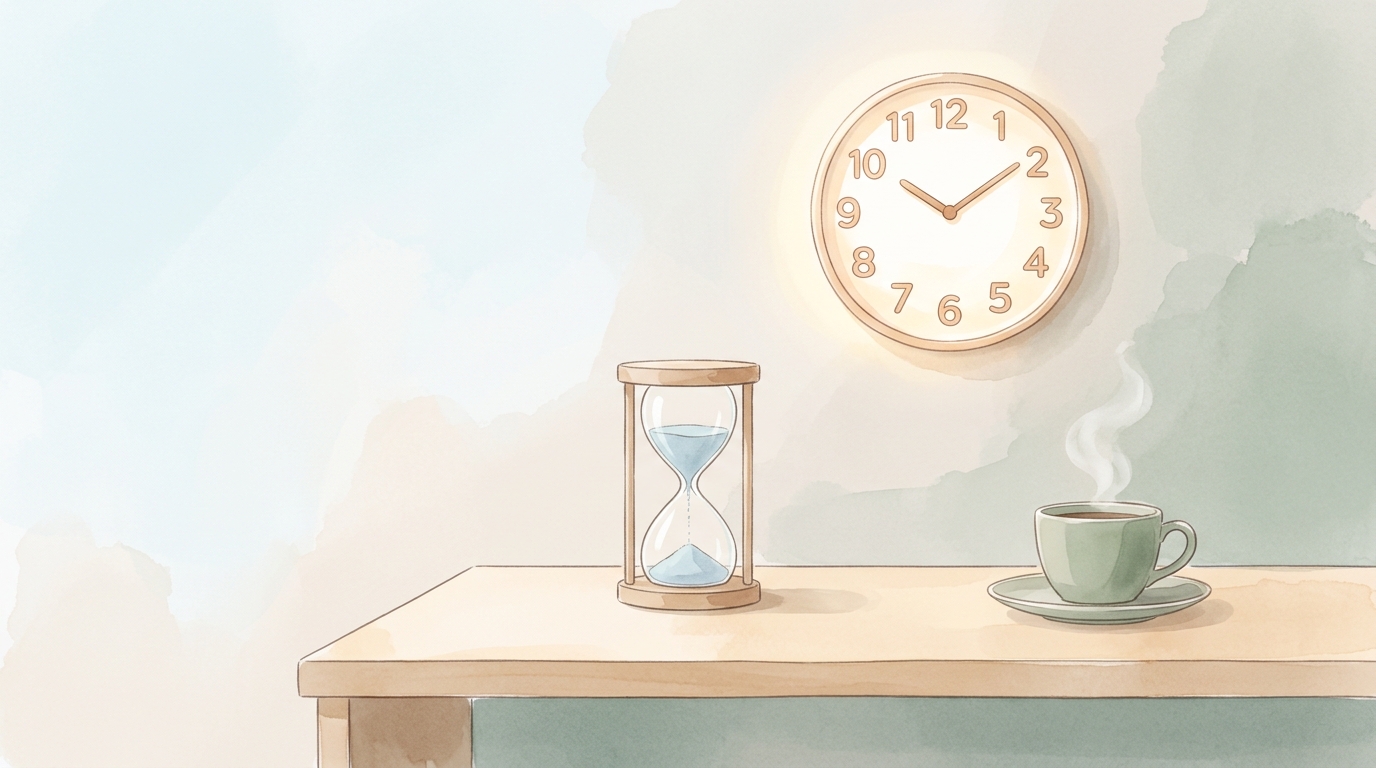
Trying to sense time in your head creates mental fatigue. Instead, move time tracking directly into your physical space.
Time-assistive tools turn abstract minutes into clear visual cues. Place simple, quiet clocks in every room you use daily.
Use a visual timer that shows time as a shrinking colored disk. This lets your brain process time through vision rather than memory.
You can also anchor actions to physical events instead of clock times. For example, open your task list right after your morning coffee mug touches your desk.
Use Buffer Math to Create Realistic Schedules

We often guess task durations under perfect conditions. Real life includes cognitive drift, transition delays, and slow starts.
You can fix this with empirical duration tracking and buffer math. First, time five recurring daily routines using a quiet stopwatch.
Log the actual minutes they take over several days. Next, multiply that real timed average by 1.5.
Finally, add a ten-minute transition buffer between tasks. If writing an email takes twenty minutes, block out forty minutes total.
Build Simple Plans and Use Gentle Resets

Starting a task causes friction when expectations feel too large. You can make transitions easier by using simple If-Then plans.
Define a clear trigger and your immediate small response. For example: If I sit down, then I will open one document.
Reduce high-friction tasks to their smallest step, called a minimum viable action. Write just one heading instead of a whole report.
If your schedule breaks, pause without self-criticism. Clear your current board and execute the very next physical step.
Moving Forward with Calm Confidence
Managing time with ADHD is not about pushing harder. It is about designing an environment that supports your brain.
When you stop relying on internal clocks, daily stress decreases. Start small by choosing one external anchor today.
Time one routine, or add visual timers to your workspace. Treat your schedule as a supportive guide rather than a strict test.
With supportive tools and calibrated buffers, you can build a steady, compassionate routine.
Build a productivity system around your real capacity
If these strategies resonated with you, our comprehensive guide will give you a full toolkit to start, focus, reset, and recover on low-capacity days.