Minimum Viable Action (MVA)
Stop holding time in your head; make time visible in your environment to focus with ease.
Why Time Feels Different with ADHD
Do you often lose track of time? You are not lazy or careless. Your brain simply experiences time differently.
This pattern is called time blindness. It is a natural part of ADHD.
When society expects precise timing, your environment can feel overwhelming. This creates stress and frustration.
You do not need more willpower. You simply need a system built for how your brain works.
Why Keeping Track of Time in Your Head Fails
Your brain uses working memory to feel time pass. With ADHD, keeping time in your head creates heavy cognitive load.
When you get deeply interested in a task, time seems to vanish. When a task feels boring, time drags slowly.
This creates two states: "now" and "not now." Future deadlines can feel abstract until they arrive suddenly.
Trying to force your brain to track minutes internally causes mental drain. The solution is simple: stop keeping time inside your head. Make time something you can physically see.
Simple Ways to Externalize Time

Externalizing time means taking clock tracking out of your mind and putting it into your room.
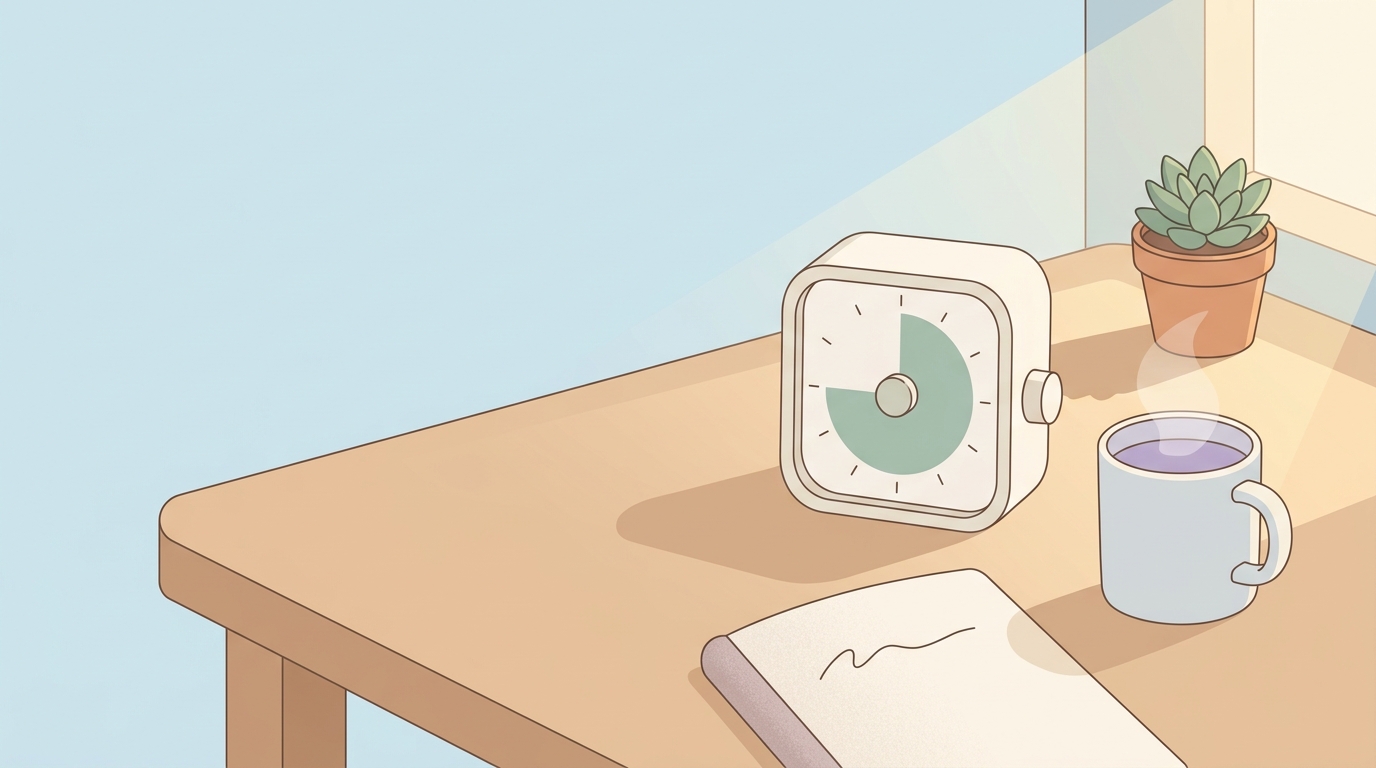
- Use a visual sweep timer: These clocks show remaining time as a shrinking colored disk. You see time without thinking about numbers.
- Break large tasks into tiny steps: We call this a Minimum Viable Action. Instead of writing a full report, start by opening a document. Write just one sentence.
- Work in short blocks: Use ten to fifteen minute windows. Short windows keep your mind fresh and reduce burnout.
Building Safe Spaces for Your Natural Rhythm

Constant rushing strains your nervous system. You need spaces where external clocks do not rule your day.
Create an "Own-Time Space." This is a quiet area or window of time free from strict schedules.
In this space, your mind can explore without judgment. It lets your nervous system rest and reset.
Transitions between tasks can also feel hard. Give yourself gentle warnings before changing activities. Use soft chimes or subtle watch vibrations to switch tasks smoothly.
Moving Forward with Calm and Compassion
Time blindness is not a personal failure. It is a sign of an environmental mismatch.
When you make time visible, you remove the heavy burden from your working memory.
Start small today. Pick one visual tool or try a two-minute action.
Give yourself grace when time slips away. Focus on building supportive tools, not changing who you are. Your worth is not measured by a clock.
Build a productivity system around your real capacity
If these strategies resonated with you, our comprehensive guide will give you a full toolkit to start, focus, reset, and recover on low-capacity days.